The Marian Record — Miracles Section
Quick Reference
| Title | The Kardiotissa, the Tender Heart |
| Type | Myrrh-streaming icon of the Theotokos, of the Eleousa (tenderness) type |
| Began Streaming | Autumn 2011, and continuing |
| Location | St. George Orthodox Church, Taylor, Pennsylvania (American Carpatho-Russian Orthodox Diocese, Ecumenical Patriarchate) |
| Custodian | Very Rev. Fr. Mark Leasure, pastor; Bishop Gregory of Nyssa, ruling hierarch |
| Status | Venerated within the Orthodox Church with diocesan blessing. No judgment by the Catholic Church. |
A note on what this is, and what it is not
This icon belongs to the Orthodox Church, not the Catholic Church. It is venerated by Orthodox Christians across several jurisdictions, and it travels with the blessing of its bishop, but the Catholic Church has never investigated or ruled on it. So it does not carry the kind of approval that Lourdes or Guadalupe carry.
We include it because Catholics and Orthodox share, almost completely, the same faith in the Mother of God and the same ancient practice of venerating her holy images, and because the wider record of how God has worked through Mary does not stop at the boundary between East and West. But we will not dress an Orthodox devotion in Catholic approval it does not have.
It is also a different kind of event from an apparition. No one saw Mary. What happened is that an image of her began to give off fragrant oil, and continues to. That places it in the Miracles section of this library, among the weeping and myrrh-streaming images, not among the apparitions.
What a Kardiotissa Is
The Iveron Lineage
What Happened
Word spread without advertising. Weekly Moleben services — the Orthodox prayer of supplication to the Mother of God — began to fill the small church beyond capacity, and the icon started to travel, carried to Orthodox parishes across the country: in Chicago, in Parma, in Carnegie, drawing thousands.
On the evening of 15 November 2017, Archbishop Daniel of the Ukrainian Orthodox Church of the USA led a pilgrimage of clergy and faithful to Taylor to pray before it, and the faithful were anointed with its myrrh as the church filled with the scent of it.
15 November 2017 — Taylor, Pennsylvania
The church filled with the scent of myrrh as the faithful were anointed.
Archbishop Daniel of the Ukrainian Orthodox Church of the USA led the pilgrimage. Clergy and faithful from several Orthodox jurisdictions came to pray before the Kardiotissa at St. George parish.
The Myrrh, and What It Means
Myrrh is not a random sign. It runs through the whole Gospel.
It was one of the three gifts the wise men laid before the child: “gold, frankincense, and myrrh” (Matthew 2:11). It was carried to His tomb, when Nicodemus came “bringing a mixture of myrrh and aloes” to anoint His body (John 19:39). It is the spice of kingship and of burial, of His birth and of His death. So when fragrant myrrh flows from an image of His mother holding Him, the faithful read it the way the Church has always read such things: as a quiet sign pointing to her Son, to His sacrifice, and to the sweetness the Apostle calls being “the good odour of Christ” (2 Corinthians 2:15).
Gold, frankincense, and myrrh.
— Matthew 2:11 — the gifts of the Magi at the birth of Christ
A point of care belongs here, and both Catholics and Orthodox would insist on it. The icon does not work miracles. The painted board has no power in itself. Whatever grace is given is given by God, and the honor shown to the image, as the Church defined long ago, passes not to the wood and paint but to the one it represents, and through her to her Son. The image is a window, never the light.
Veneration and Reported Fruits
Since 2011 thousands have come, and the pattern is consistent across the accounts. Pilgrims wait in long, quiet lines to be anointed with the myrrh. Some weep. Some speak of a wave of peace. Some report that the fragrance lingered on them for days. The faithful also speak of healings and answered prayers.
In keeping with the standard of this library, those reports are recorded as what they are: the testimony of the faithful, gathered by word of mouth and by the parishes that have hosted the icon. They have not been subjected to the kind of formal medical or scientific examination that, for example, the cures at Lourdes must pass. We pass them on honestly, neither inflating them into proven miracles nor dismissing them.
How the Church Weighs It
Two questions matter, and they have different answers.
On the veneration of the image itself, the Church is entirely settled, and Catholics and Orthodox agree without reservation. The Second Council of Nicaea, in the year 787, defended the holy images against those who would destroy them, and taught that the veneration shown to an icon is a respectful honor, not the adoration due to God alone, and that this honor passes to the person the image represents. The Catechism of the Catholic Church repeats it directly. So there is nothing strange or suspect to a Catholic in kneeling before an image of the Mother of God. It is the faith of the undivided Church.
On the myrrh itself, the answer is more careful. Phenomena like weeping and myrrh-streaming images are not rare in the Orthodox world, and the Orthodox themselves treat most of them with prudence, recognizing some at a diocesan level and leaving many simply to the devotion of the faithful. The Taylor icon was blessed by its bishop to be venerated and to travel. That is a real ecclesial blessing, but it is not the same as a formal verdict on the cause of the myrrh, and no published scientific study of this icon appears to exist.
The Catholic Church, for its part, has said nothing about this icon. It neither approves nor condemns it. As with every private phenomenon, a Catholic is entirely free to be moved by it or to set it aside, and is required to believe nothing about it. What the Church does ask, always, is that any such sign be measured by whether it leads people to prayer, to repentance, and to Christ. By that measure the fruit reported here — crowds praying the supplication of the Mother of God and leaving in tears and peace — is at least consonant with how Mary has always worked.
The only test that finally matters is the one Mary herself has always passed: it drew them to their knees, and it pointed them to Christ.
Current Status
ORTHODOX VENERATION — NO CATHOLIC RULING
Venerated within the Orthodox Church with the blessing of the American Carpatho-Russian Orthodox Diocese under the Ecumenical Patriarchate, and honored by faithful of several Orthodox jurisdictions. The Catholic Church has issued no judgment upon it. In this library it sits among the myrrh-streaming and weeping images of the Miracles section, recorded with respect and without exaggeration.
The Church does not require any Catholic to believe that the myrrh of the Taylor icon is miraculous. It has made no ruling on it. It does not teach that oil from an image heals by itself, and it would measure any reported cure with the same patience it shows everywhere, ruling out the ordinary before it speaks of the extraordinary. What the Church does hold, and has held since the year 787, is that to honor an image of the Mother of God is good and right, and that the honor travels through the image to her, and through her to her Son.
Primary and Authoritative Sources
- The Ukrainian Orthodox Church of the USA, report of the 15 November 2017 pilgrimage to the Kardiotissa in Taylor, Pennsylvania — the primary account of this entry.
- The American Carpatho-Russian Orthodox Diocese and the Greek Orthodox Metropolis of Chicago, for the icon’s travels and veneration.
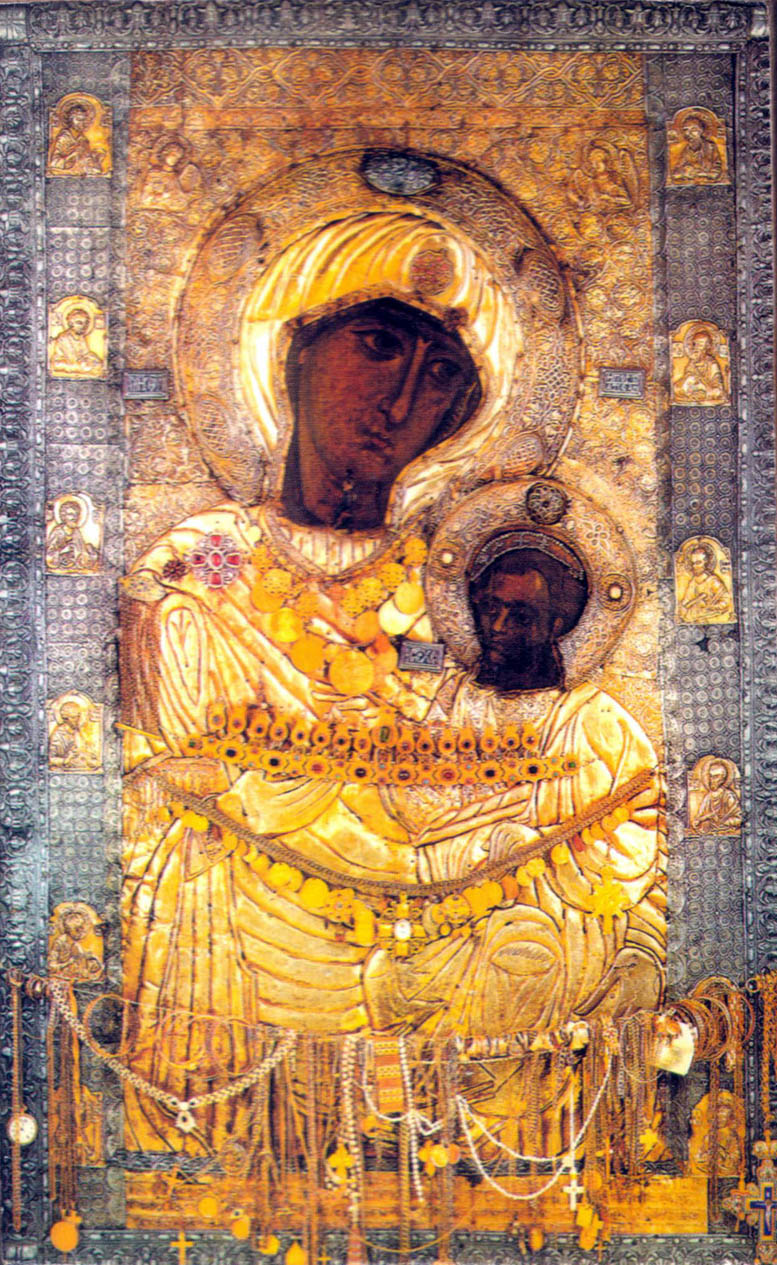
- The Orthodox Hawaiian Iveron Icon Association and OrthoChristian, for the Iveron lineage from Mount Athos through the Montreal and Hawaiian icons.
- The Russian Orthodox Church Outside Russia, for the 2008 recognition of the Hawaiian Iveron icon.
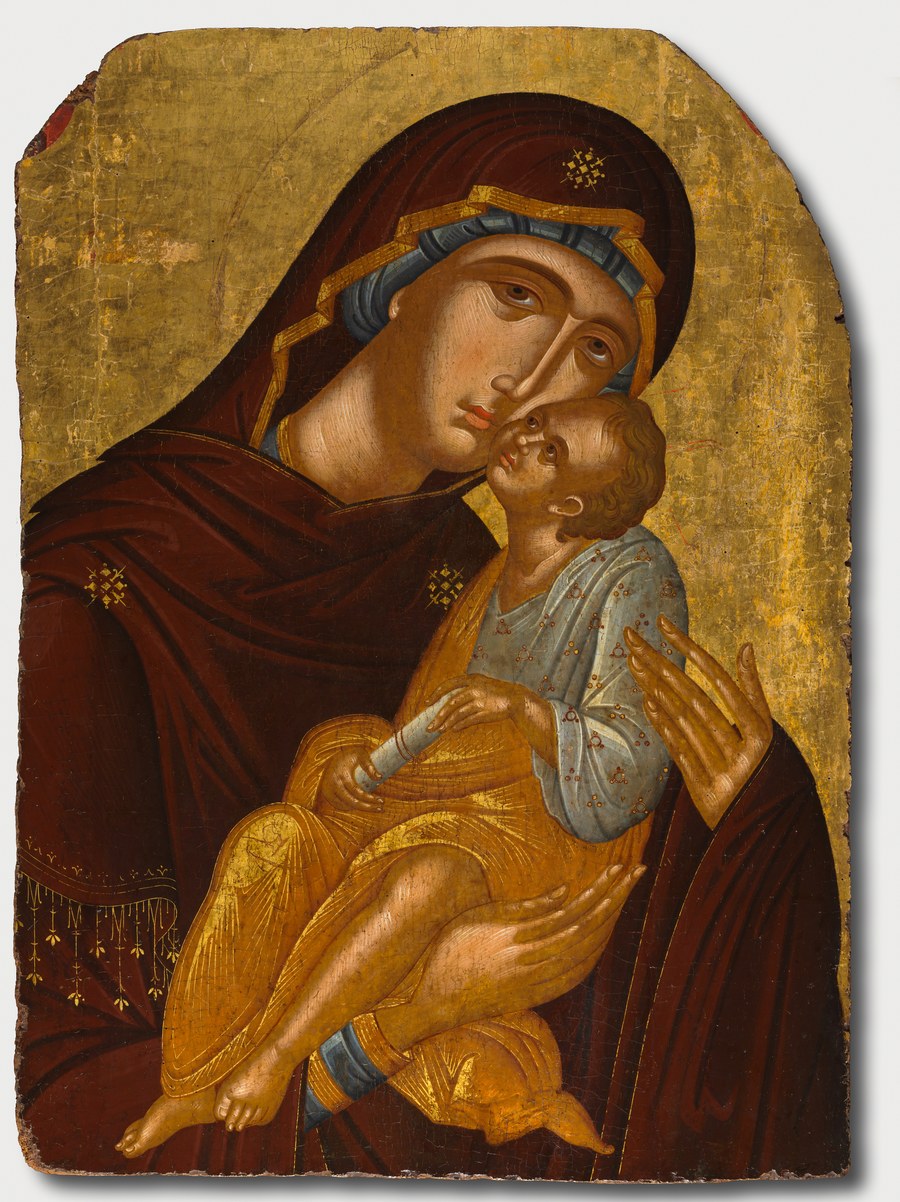
- For the iconographic type: the works of Angelos Akotantos held by the Cleveland Museum of Art (open-access) and the Byzantine and Christian Museum in Athens.
- For the doctrine of images: the Second Council of Nicaea (787) and the Catechism of the Catholic Church.
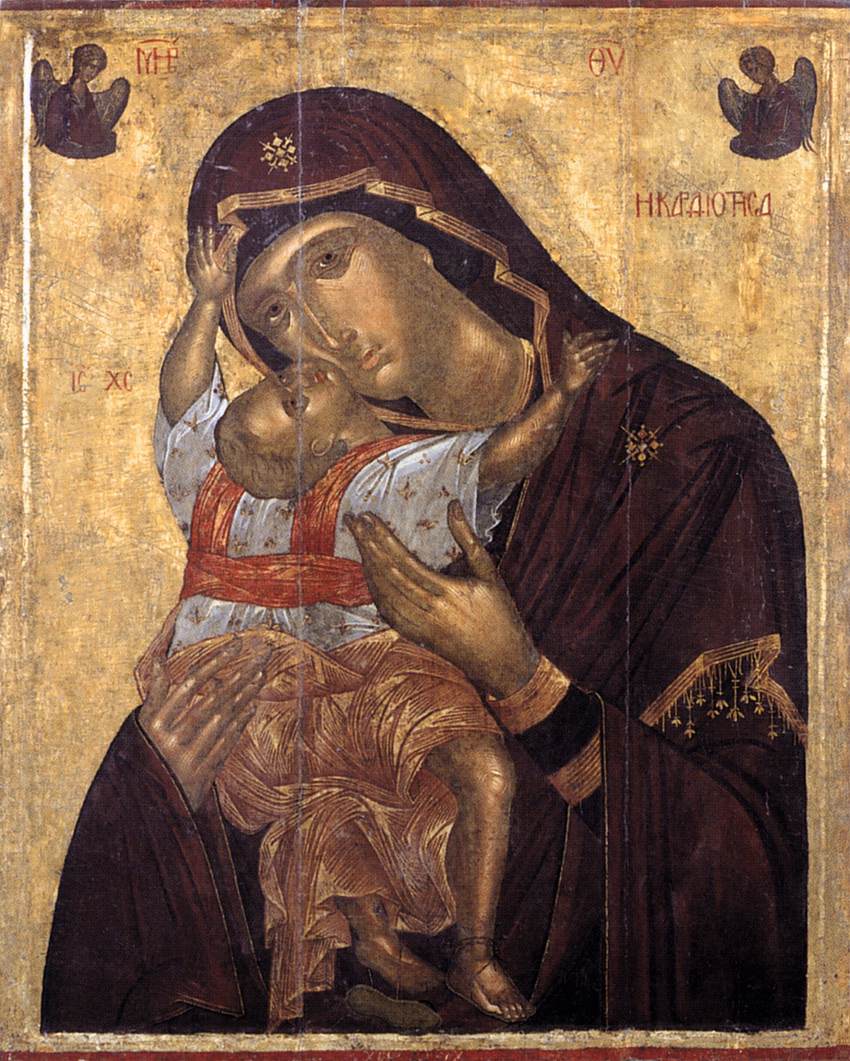
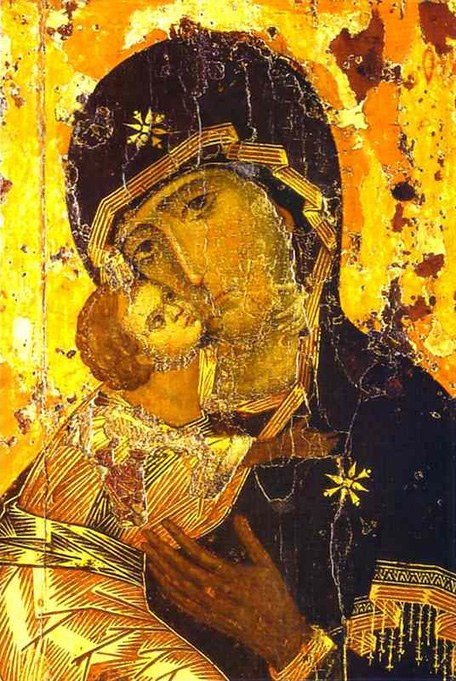
The photographs of the actual Taylor Kardiotissa streaming myrrh are the property of the parish and the Orthodox Church that took them. They are copyrighted and have not been used here. The images on this page show public-domain icons of the same Eleousa and Kardiotissa type — the Akotantos prototypes and the Theotokos of Vladimir — and are captioned accordingly. They illustrate the tradition the Taylor icon belongs to; they are not photographs of the Taylor icon itself.
This entry is part of The Marian Record, a library of approved and historically documented Marian apparitions, titles, and miracles maintained by protectmary.com/. All artwork is public domain. All historical claims are drawn from primary ecclesiastical documents and standard scholarly sources. This entry records an Orthodox devotion; it does not carry Catholic approval, and no Catholic is required to believe anything about it.