We are not here to win an argument. We are here to introduce you to your mother. These are the questions we hear most often, answered as honestly and gently as we can.
TWO WORDS THAT DECIDE EVERYTHING
The Catholic tradition has always distinguished between two kinds of honor. Latria is the worship that belongs to God alone. Dulia is the honor given to holy persons. Hyperdulia is the highest form of dulia, reserved for Mary. Catholics do not worship Mary. They honor her. The distinction is not a modern invention. It was articulated by the Church Fathers in the fourth century.
"Catholics worship Mary. That is idolatry."
This is the most common objection, and it rests on a misunderstanding of what Catholics actually do. Catholics do not worship Mary. They honor her. The Mass, the sacraments, the sacrifice of the altar: all of these are directed to God alone. Mary is asked to pray, just as you might ask a friend to pray for you.
The Council of Trent, the Second Vatican Council, and the Catechism of the Catholic Church all explicitly state that the honor given to Mary is not worship. It is veneration. The Greek word the early Church used was proskunesis for worship and timetike for honor. They were not the same word because they were not the same thing.
"And it came to pass, that, when Elisabeth heard the salutation of Mary, the babe leaped in her womb; and Elisabeth was filled with the Holy Ghost: And she spake out with a loud voice, and said, Blessed art thou among women, and blessed is the fruit of thy womb."
Luke 1:41-42 (KJV)Elizabeth, filled with the Holy Spirit, called Mary blessed. Catholics follow her example.
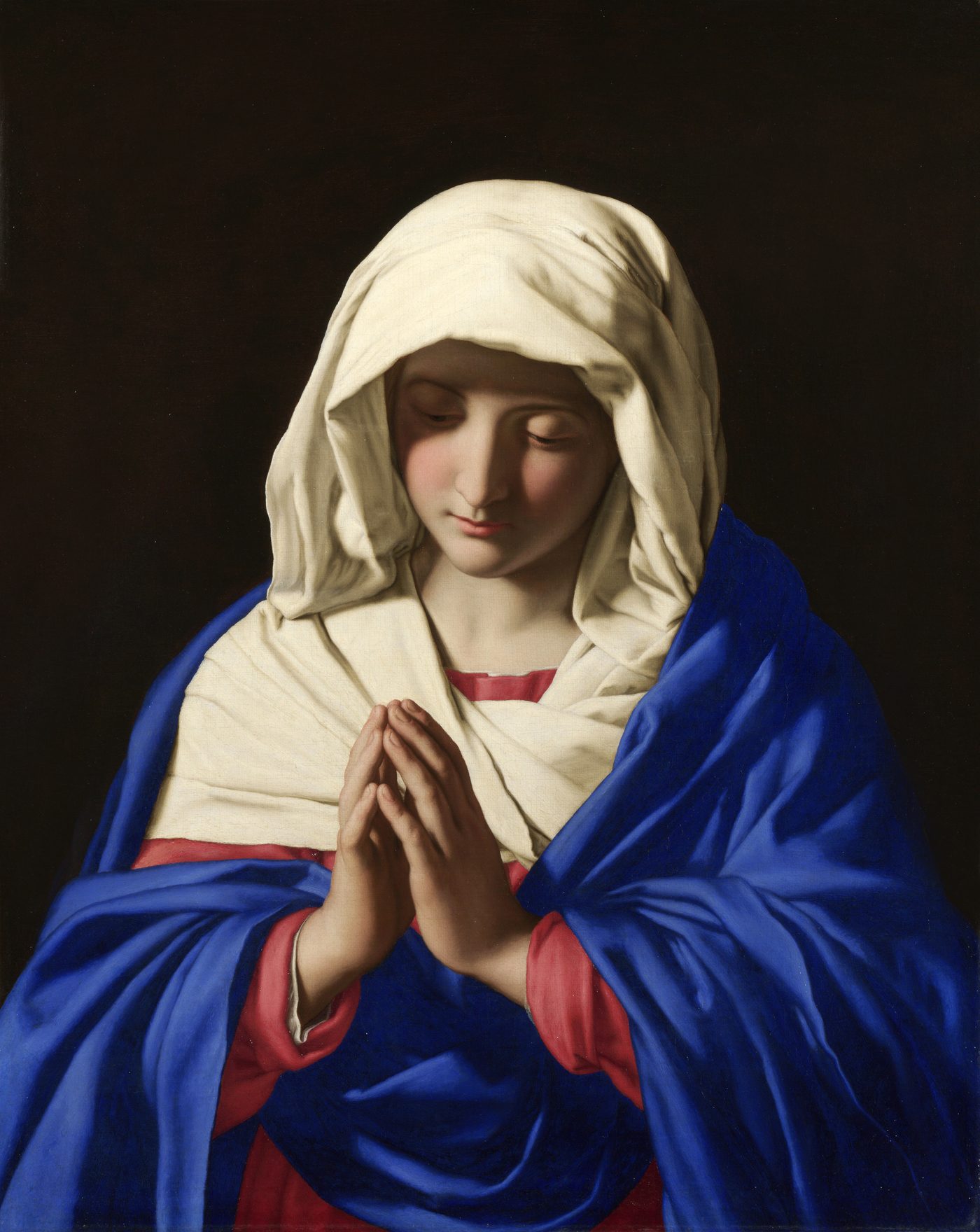
Sassoferrato, The Virgin in Prayer, c. 1640. National Gallery, London. Public domain.
"The Bible says there is one mediator between God and man. That is Jesus Christ."
1 Timothy 2:5 is one of the most cited verses in this conversation, and it is absolutely true: "For there is one God, and one mediator between God and men, the man Christ Jesus." Catholics agree completely. Christ is the one mediator.
But the same passage, just two verses earlier, says: "I exhort therefore, that, first of all, supplications, prayers, intercessions, and giving of thanks, be made for all men." Paul asks Christians to intercede for one another. If all human intercession violated the sole mediation of Christ, Paul would be contradicting himself in the same paragraph.
When Catholics ask Mary to pray for them, they are not bypassing Christ. They are asking a member of the Body of Christ to join her prayers to theirs, all of which flow through Christ to the Father. Mary does not mediate instead of Christ. She mediates in Christ, through Christ, and because of Christ.
"I exhort therefore, that, first of all, supplications, prayers, intercessions, and giving of thanks, be made for all men."
1 Timothy 2:1 (KJV)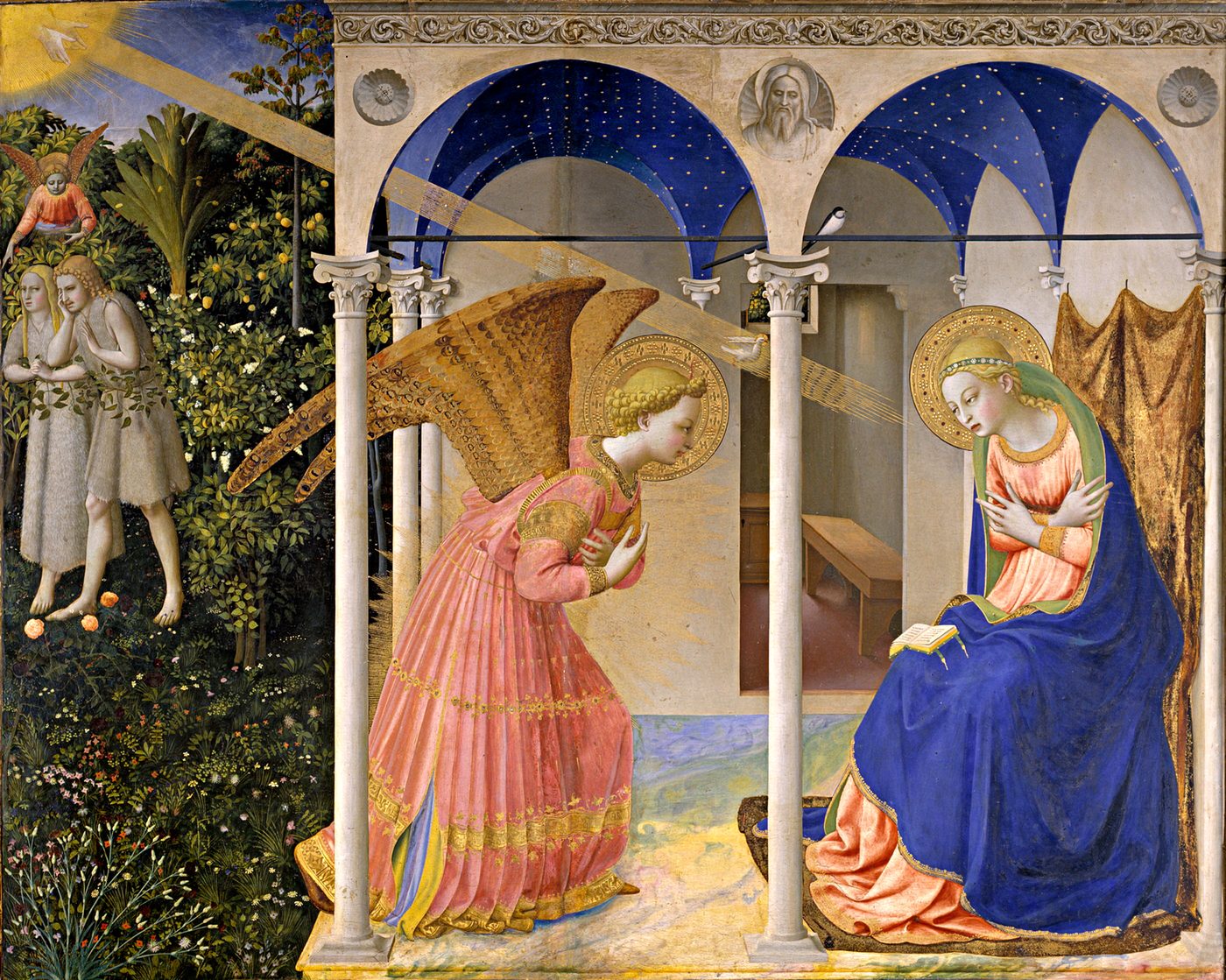
Fra Angelico, The Annunciation, c. 1426. Prado Museum, Madrid. Public domain.
"Praying to Mary is praying to the dead. The Bible forbids necromancy."
This objection assumes that Mary is dead in the same way that all human beings are dead before the resurrection. But Christians believe in the communion of saints, which means that those who have died in Christ are not simply gone. They are alive in him.
Jesus himself addressed this directly. When the Sadducees argued that there was no resurrection, he replied: "God is not the God of the dead, but of the living: for all live unto him." (Luke 20:38). The saints are alive. They are not unreachable. They are more present to God than we are.
Necromancy, which the Bible forbids, is the attempt to summon the dead for information or power. Asking a saint to pray for you is no more necromancy than asking a living friend to pray for you. The difference is that the saint is in the presence of God.
"For he is not a God of the dead, but of the living: for all live unto him."
Luke 20:38 (KJV)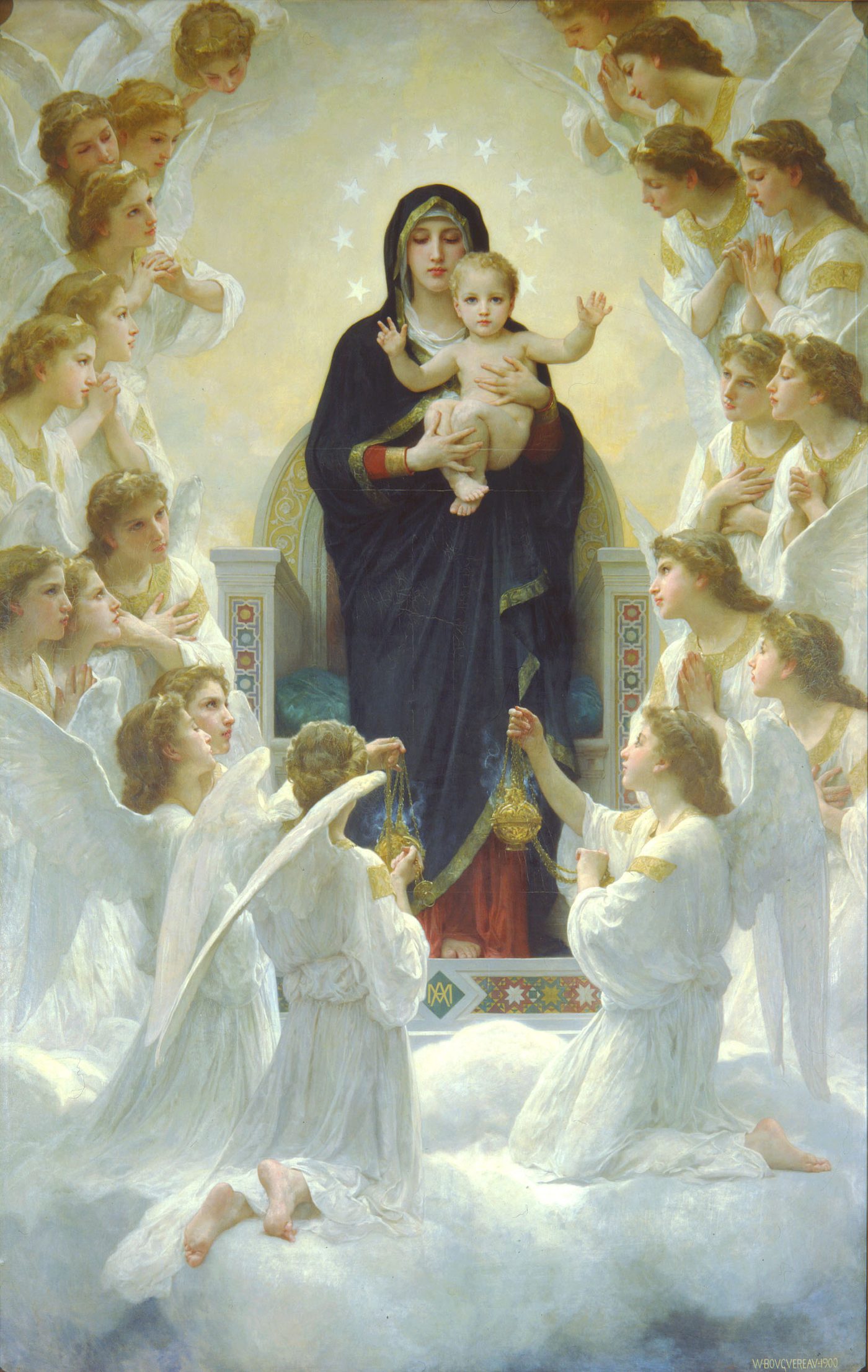
Bouguereau, Regina Angelorum, 1900. Public domain.
"Mary was just a vessel. She has no special role now that Jesus has been born."
This view is difficult to reconcile with the New Testament itself. At the wedding at Cana, Mary notices that the wine has run out and brings the need to Jesus. He performs his first public miracle at her request. This is not the behavior of someone whose role has ended.
At the foot of the cross, Jesus gives her to the beloved disciple: "Woman, behold thy son. Then saith he to the disciple, Behold thy mother. And from that hour that disciple took her unto his own home." (John 19:26-27). Jesus does not give her away because she is no longer needed. He gives her to the Church because she is still needed.
The Book of Revelation presents a woman clothed with the sun, with the moon under her feet and a crown of twelve stars, who is the mother of the one who rules all nations. The Church has always seen Mary in this image.
"And there appeared a great wonder in heaven; a woman clothed with the sun, and the moon under her feet, and upon her head a crown of twelve stars."
Revelation 12:1 (KJV)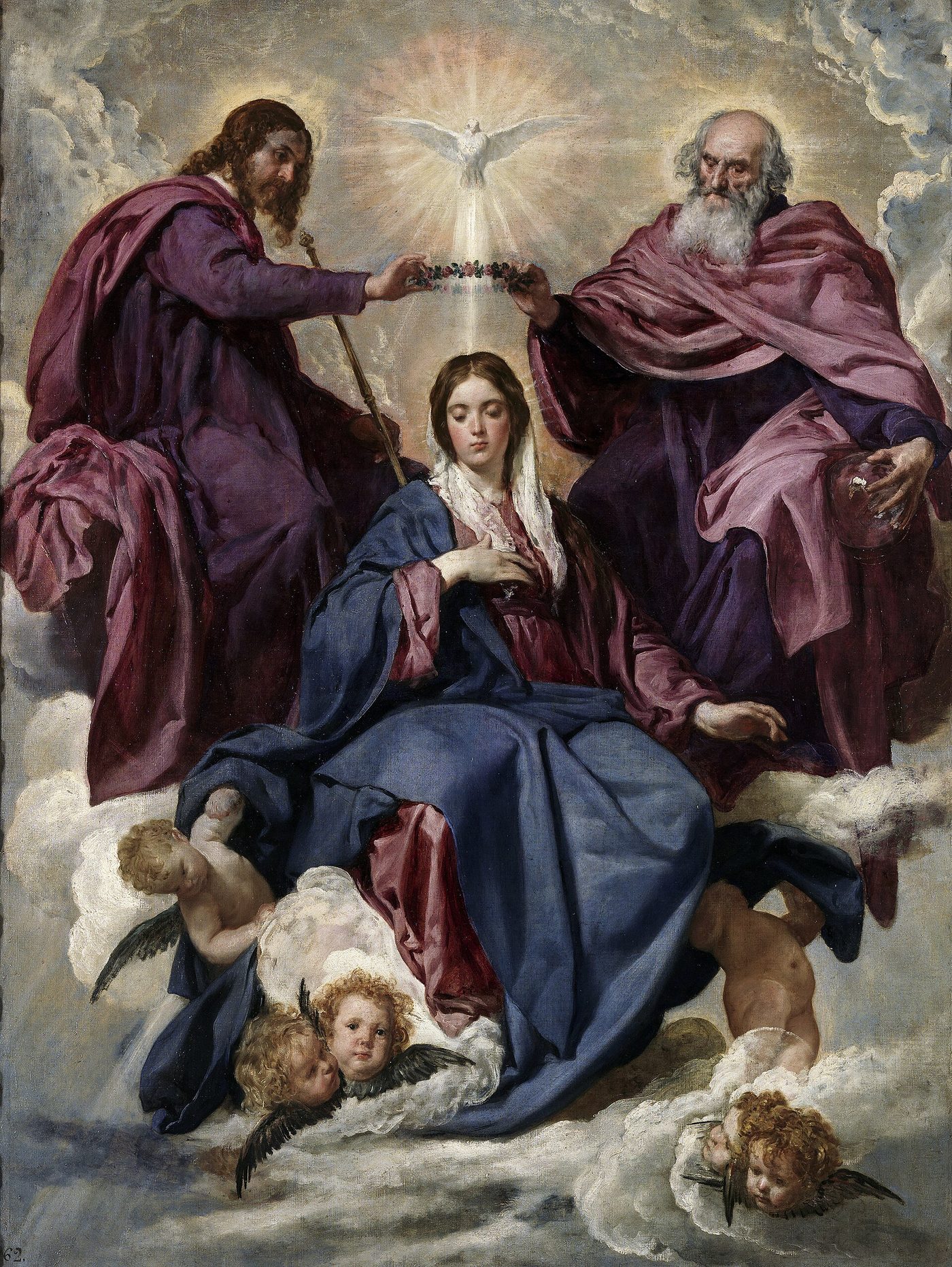
Velazquez, The Immaculate Conception, c. 1618. National Gallery, London. Public domain.
"The Immaculate Conception is not in the Bible."
The doctrine of the Immaculate Conception holds that Mary was preserved from original sin from the moment of her conception, by the merits of Christ applied to her in advance. It is a doctrine about grace, not about biology.
The biblical foundation begins in Genesis 3:15, where God says to the serpent: "And I will put enmity between thee and the woman, and between thy seed and her seed." The Church has always read this as the first announcement of Mary, the new Eve, who would be in complete enmity with the serpent. Complete enmity requires freedom from his power, which is sin.
The angel Gabriel greets her with a word that appears nowhere else in the New Testament: kecharitomene, which means "one who has been and remains filled with grace." The perfect passive participle indicates a completed action with ongoing effect. She is not merely receiving grace at that moment. She has been graced from the beginning.
"And the angel came in unto her, and said, Hail, thou that art highly favoured, the Lord is with thee: blessed art thou among women."
Luke 1:28 (KJV)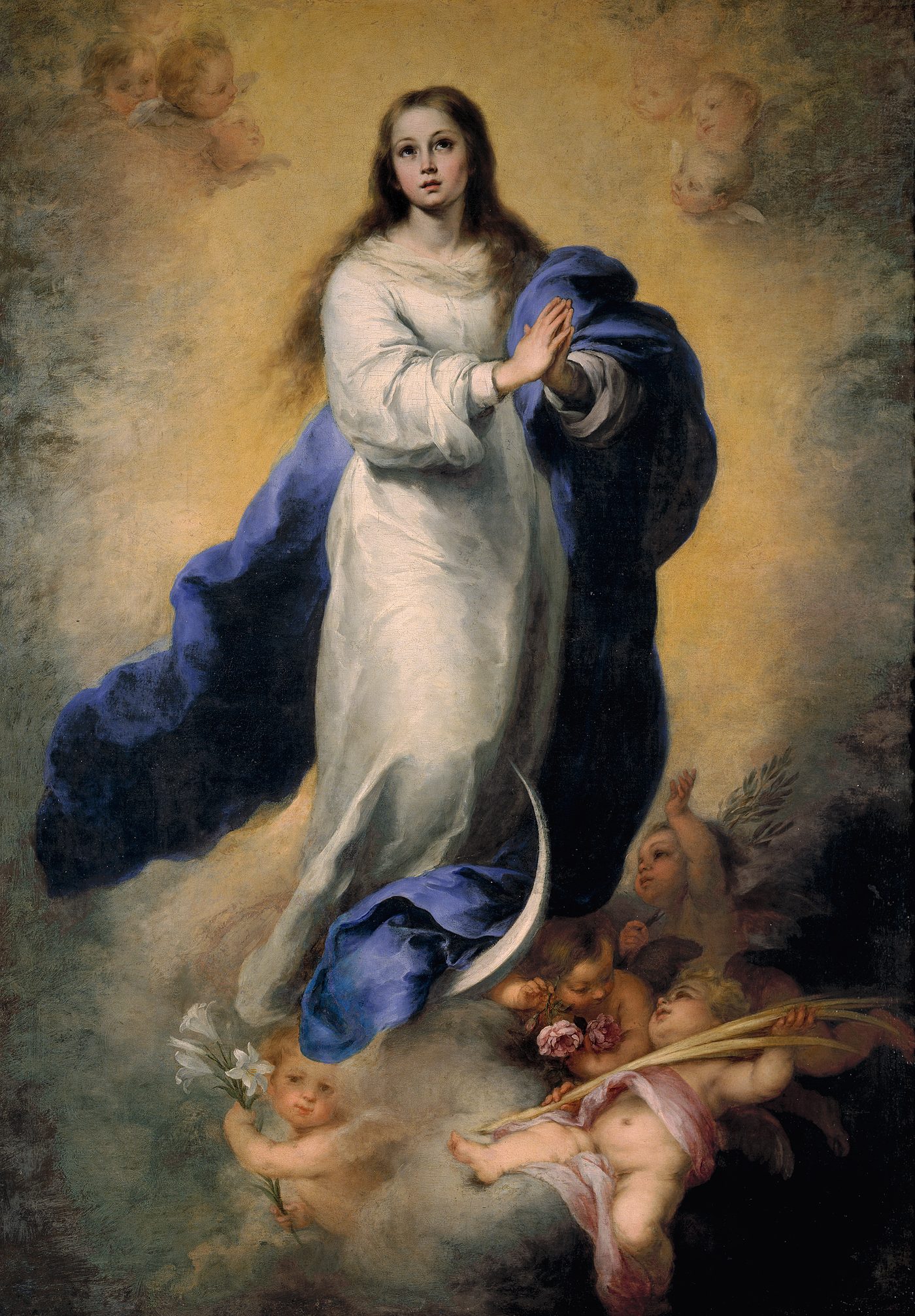
Murillo, The Immaculate Conception of El Escorial, c. 1660. Prado Museum, Madrid. Public domain.
"The Rosary is vain repetition. Jesus warned against that."
In Matthew 6:7, Jesus says: "But when ye pray, use not vain repetitions, as the heathen do: for they think that they shall be heard for their much speaking." The key word is vain. The warning is against empty, thoughtless repetition, not against repetition itself.
The Psalms are full of repeated refrains. The angels in Revelation cry "Holy, holy, holy" without ceasing. The same Jesus who warned against vain repetition spent the night before his death praying the same prayer three times in Gethsemane.
The Rosary is not a magic formula. It is a meditation on the life of Christ, structured around the Joyful, Sorrowful, Glorious, and Luminous Mysteries. The repeated Hail Marys are not the point. They are the rhythm that carries the mind into contemplation of the Gospel. Many people who have prayed it seriously have found it to be one of the most Christ-centered forms of prayer they have encountered.
"And he went a little further, and fell on his face, and prayed, saying, O my Father, if it be possible, let this cup pass from me: nevertheless not as I will, but as thou wilt. He went away again the second time, and prayed, saying the same words."
Matthew 26:39, 42 (KJV)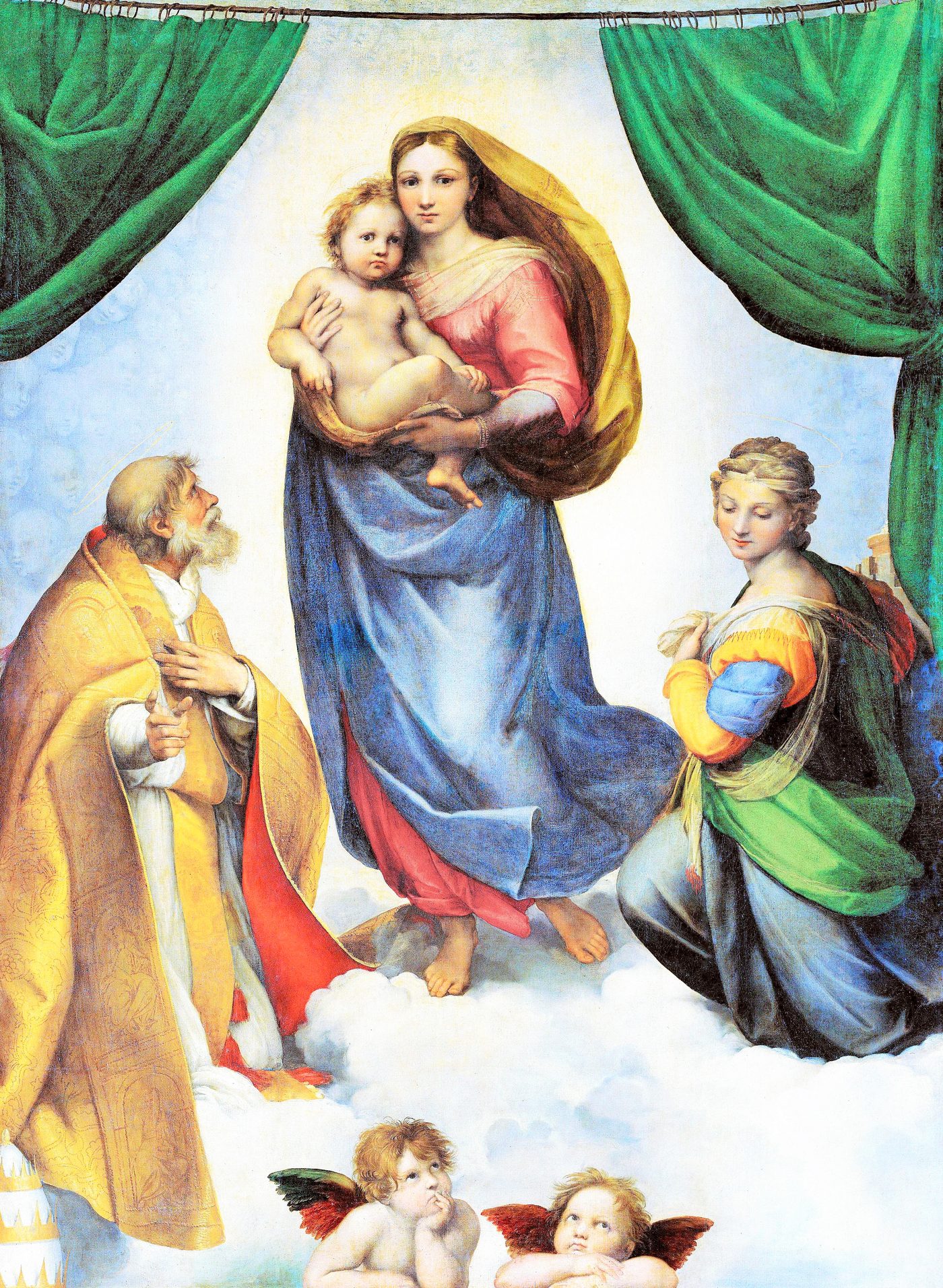
Raphael, Sistine Madonna, 1512. Gemaldegalerie Alte Meister, Dresden. Public domain.
If these answers have opened a door, even slightly, we invite you to take the next step.