These are not Catholic inventions. They are the faith of the ancient Church, held by Christians for centuries before the Reformation. We offer them not as arguments, but as introductions.
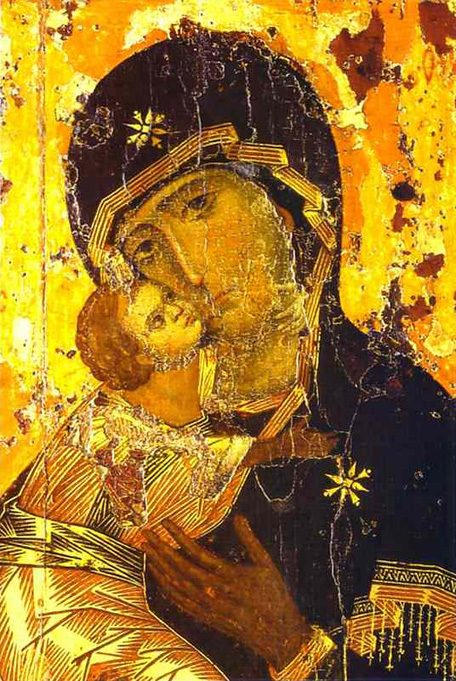
Our Lady of Vladimir, Byzantine icon, c. 12th century. Tretyakov Gallery, Moscow. Public domain.
Theotokos: Mother of God
The title Theotokos, meaning "God-bearer" or "Mother of God," was formally defined at the Council of Ephesus in 431 AD. But it was not invented there. Christians had been calling Mary Theotokos for at least a century before the council met.
The council was not primarily about Mary. It was about Christ. The question was whether Jesus was truly one person, divine and human, or two persons loosely joined. If Jesus is one person, and that person is divine, then his mother is the mother of a divine person. To deny the title Theotokos was to deny the unity of Christ.
This is why the title matters. It is a statement about Jesus before it is a statement about Mary. She is the Mother of God not because she is divine, but because her son is.
"And whence is this to me, that the mother of my Lord should come to me?"
Luke 1:43 (KJV)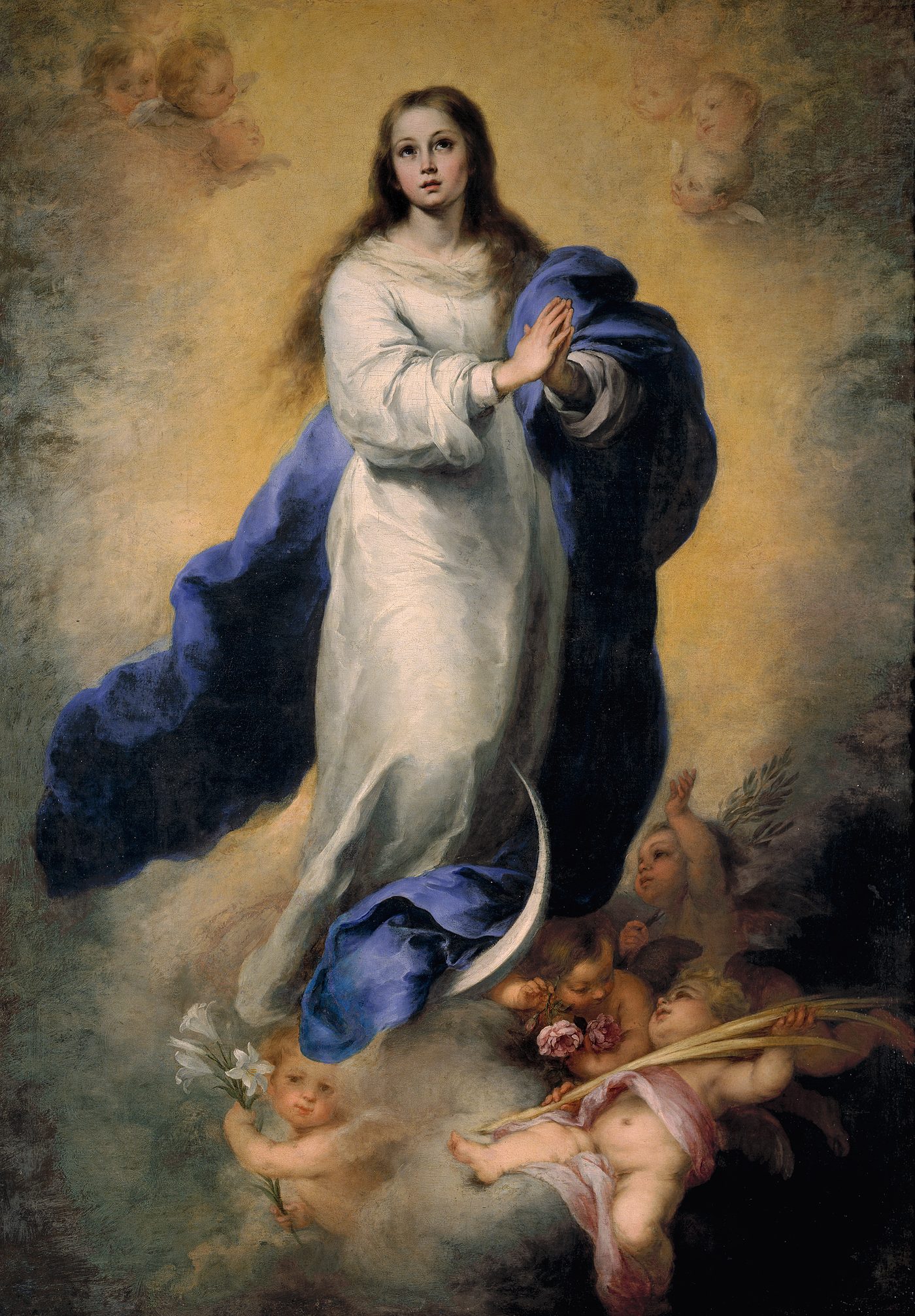
Murillo, The Immaculate Conception of El Escorial, c. 1660. Prado Museum, Madrid. Public domain.
The Immaculate Conception
The Immaculate Conception does not refer to the virginal conception of Jesus. It refers to Mary herself, and to her own conception in the womb of her mother Anne. The doctrine holds that Mary was preserved from original sin from the first moment of her existence, by the merits of Christ applied to her in advance.
This is not a doctrine about Mary being divine. It is a doctrine about grace. God can apply the grace of redemption forward in time as easily as backward. Mary was redeemed, but she was redeemed preemptively, before sin could take hold.
The logic is this: if God was going to take on human flesh, he would prepare a fitting dwelling. A temple is consecrated before the ark is placed within it. Mary is the new Ark of the Covenant, and she was consecrated before the Word was placed within her.
"And I will put enmity between thee and the woman, and between thy seed and her seed; it shall bruise thy head, and thou shalt bruise his heel."
Genesis 3:15 (KJV)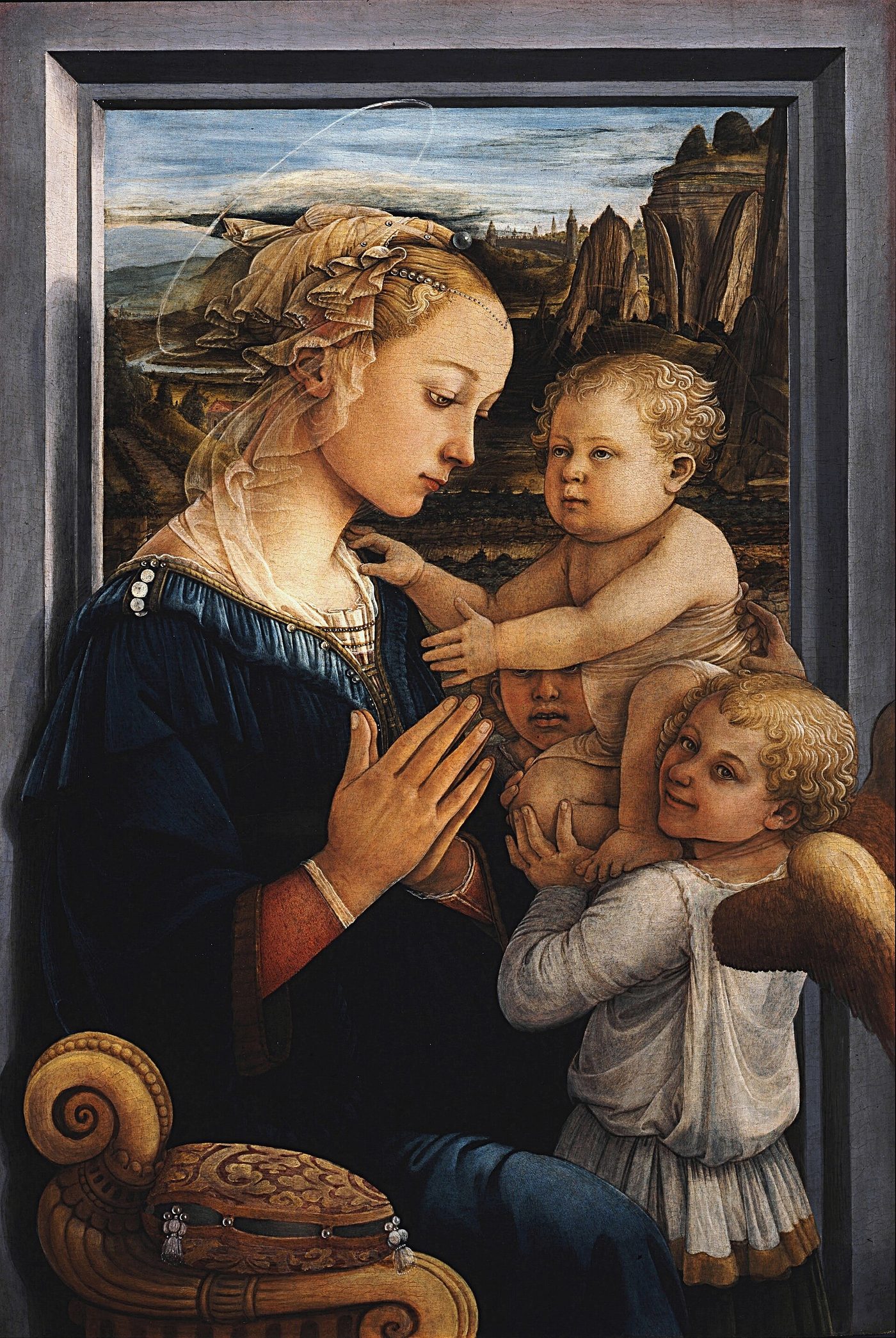
Carlo Dolci, Madonna in Sorrow, c. 1655. Public domain.
Ever Virgin
The perpetual virginity of Mary was held by virtually all Christians until the Reformation. It was affirmed by Origen, Jerome, Augustine, and the great councils of the early Church. It is not a Catholic novelty. It is the ancient faith.
The "brothers of the Lord" mentioned in the Gospels are understood by the Catholic and Orthodox traditions as either cousins (the Greek word adelphos was used for both in a Jewish context) or as children of Joseph from a previous marriage. The Eastern Church has always held the latter view. The Western Church has generally held the former.
The deeper question is not biological but theological. Mary consecrated herself entirely to God. Her virginity is not a limitation. It is a gift, freely given, and it is part of what makes her the perfect image of the Church, which is the bride of Christ.
"Then said Mary unto the angel, How shall this be, seeing I know not a man?"
Luke 1:34 (KJV)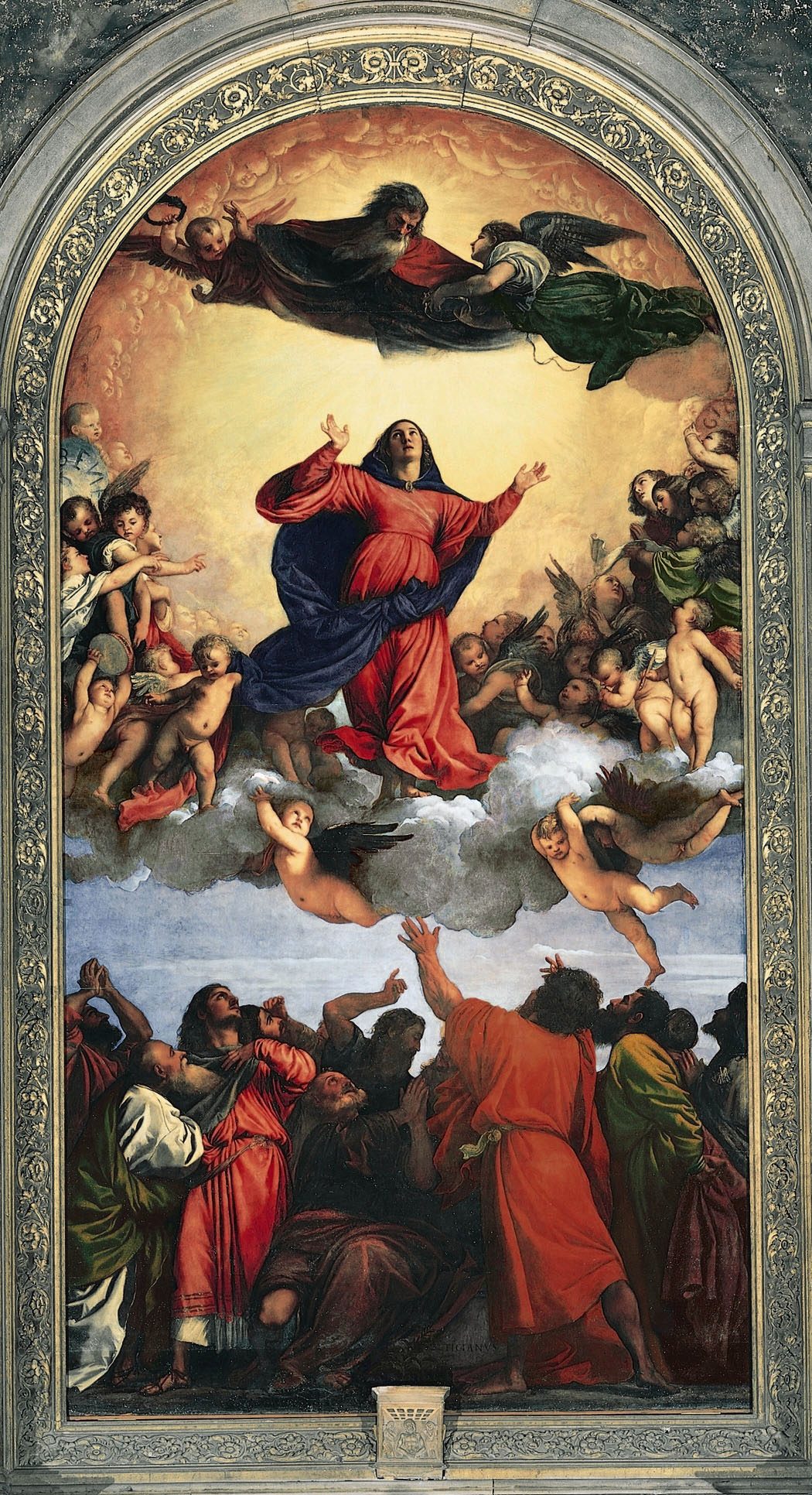
Titian, Assumption of the Virgin, 1516-1518. Santa Maria Gloriosa dei Frari, Venice. Public domain.
The Assumption
The Assumption holds that at the end of her earthly life, Mary was taken body and soul into heavenly glory. It was defined as dogma by Pope Pius XII in 1950, but it had been celebrated as a feast in the Eastern Church since at least the sixth century, and in the Western Church since the seventh.
The doctrine does not specify whether Mary died before being assumed, or whether she was assumed without dying. The Eastern Church speaks of the Dormition, the falling asleep, while the Western Church speaks of the Assumption. Both agree that she is now with God in body and soul.
The theological foundation is the same as the Immaculate Conception: if Mary was preserved from original sin, she was preserved from its consequence, which is bodily corruption. The woman who bore the body of Christ would not be abandoned to the grave.
"And there appeared a great wonder in heaven; a woman clothed with the sun, and the moon under her feet, and upon her head a crown of twelve stars."
Revelation 12:1 (KJV)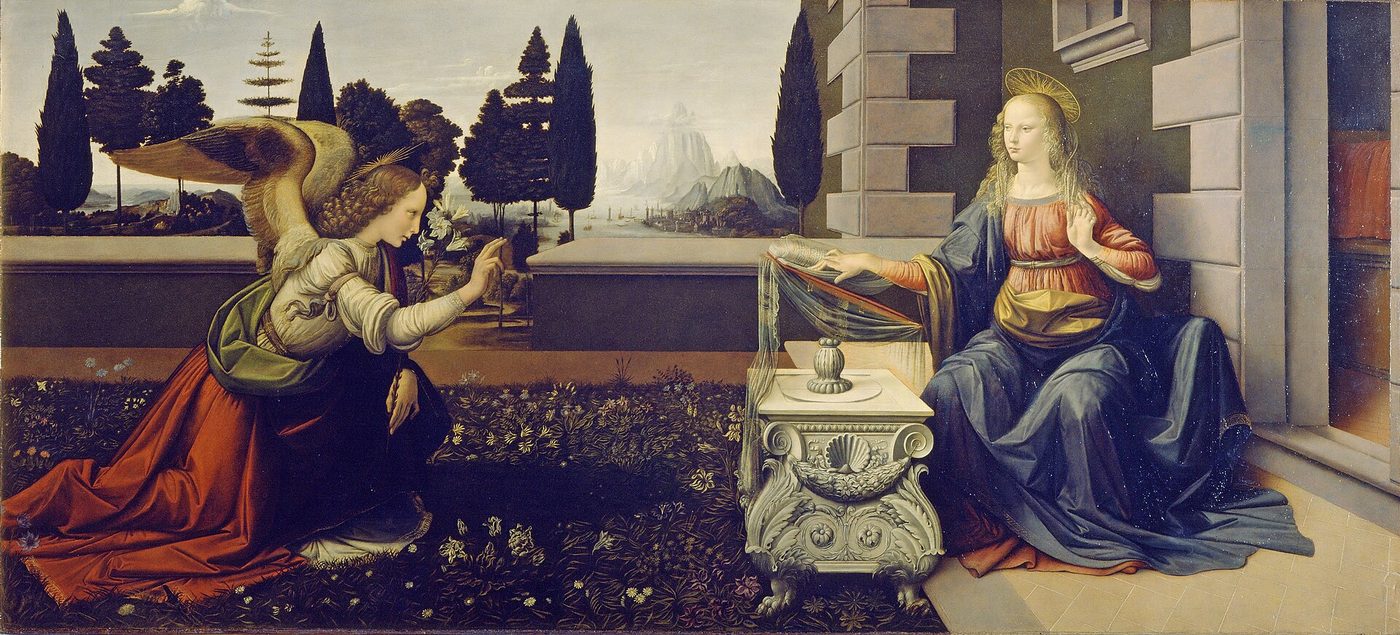
Leonardo da Vinci, The Annunciation, c. 1472-1476. Uffizi Gallery, Florence. Public domain.
The New Eve
The earliest Christian writers saw a parallel between Eve and Mary that runs through the whole of salvation history. Justin Martyr, writing around 155 AD, was the first to articulate it clearly: "Eve, who was a virgin and undefiled, having conceived the word of the serpent, brought forth disobedience and death. But the Virgin Mary received faith and joy, when the angel Gabriel announced the good tidings to her."
Eve said no to God and yes to the serpent. Mary said yes to God and no to the serpent. Eve brought death into the world through her disobedience. Mary brought life into the world through her obedience. The parallel is not incidental. It is structural.
This is why John's Gospel presents Mary at the beginning of Jesus's ministry (the wedding at Cana) and at the end (the foot of the cross), and why Jesus addresses her both times as "Woman." The word echoes Genesis. She is the Woman of Genesis 3:15, the one whose seed would crush the serpent's head.
"And Mary said, Behold the handmaid of the Lord; be it unto me according to thy word."
Luke 1:38 (KJV)These are not the end of the conversation. They are the beginning. She is patient. She has been waiting.